
A Multi-Stage Diagnostic Support Framework for Sjögren’s Syndrome
Department of Ophthalmology, Peking University First Hospital
The University of Hong Kong
A clinically aligned, multi-stage “copilot” framework that integrates ocular imaging and systemic evidence to support earlier, more reliable Sjögren’s syndrome assessment.
Highlights
A concise, reader-friendly overview of what the work contributes and why it matters.
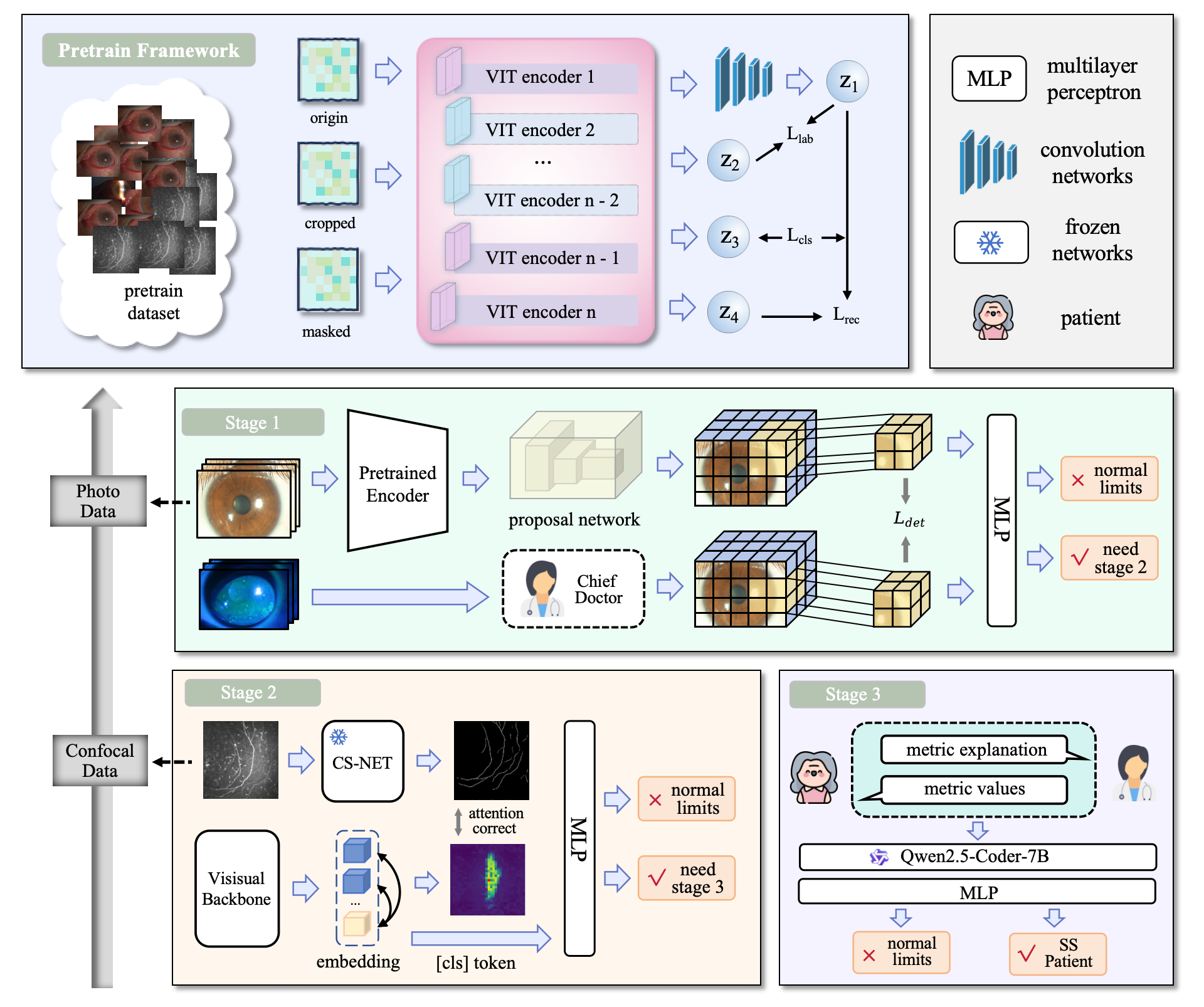
Mirrors the diagnostic pathway: screening → imaging assessment → systemic work-up integration.
Stage-wise outputs (e.g., localized suspicious regions / attention focus) support auditability.
Built for decision support under time pressure while keeping clinicians in the loop.
Research-use notice: This page is for scientific communication. The software is not a certified medical device and does not replace professional clinical judgment.
Abstract
Diagnosing Sjögren’s syndrome is challenging because it requires integrating heterogeneous evidence across ocular imaging and systemic laboratory work-up, while labeled data can be limited in real clinical settings. We present a pre-trained, multi-stage decision-support framework that combines ocular images and clinical/laboratory parameters. The framework is evaluated in multi-center, real-world cohorts and is designed to assist clinicians by providing stage-wise risk stratification and interpretable evidence.
Method overview
The system follows a staged pathway: learn robust ocular representations from unlabeled data, then perform modality-specific decisions with targeted modules.
Analyze dye-stained anterior-segment photos to identify suspicious tear-film break-up regions and determine risk.
Assess corneal nerves with attention refinement to focus on clinically relevant structures.
Integrate serological/immunological metrics to support a final stage-wise decision.
Results at a glance
A lightweight snapshot (see the paper for full experimental details and ablations).
| Evidence condition | Accuracy (system) | Recall (system) | Notes |
|---|---|---|---|
| Anterior-segment photos | 0.68 | 1.00 | High-sensitivity screening objective; supports ruling-out in low-risk cases. |
| Confocal microscopy (IVCM) | 0.71 | 1.00 | Attention refinement emphasizes clinically meaningful nerve structures. |
| Serological / immunological lab data | 0.78 | 0.95 | Feature integration supports final-stage decision support. |
The intended use is decision support: provide evidence and explanations to help clinicians make faster, more consistent judgments.
Resources
Quick access for readers, reviewers, and collaborators.
Citation (BibTeX)
Update with final venue information after acceptance.
@article{alphaoculist2025,
  title  = {A Multi-Stage Diagnostic Support Framework for Sjögren’s Syndrome},
  author = {Li, Yaxuan and Zhou, Wenyan and Lu, Chixiang and He, Xiaojun and Feng, Yun and Jiang, Haibo},
  year   = {2025},
  note   = {Manuscript}
}
Contact
Add the final corresponding-author details here if needed.
yaxuanli.cn@gmail.com · fengyun@bjmu.edu.cn · hbjiang@hku.hk